Carol Garboden Murray, M.Ed.
Join the Illuminating Care Facebook Page!
  • Home
  • Articles
  • ILLUMINATING CARE
  • 7 lamps of care
  • Blog
  • Sign Language
  • Contact

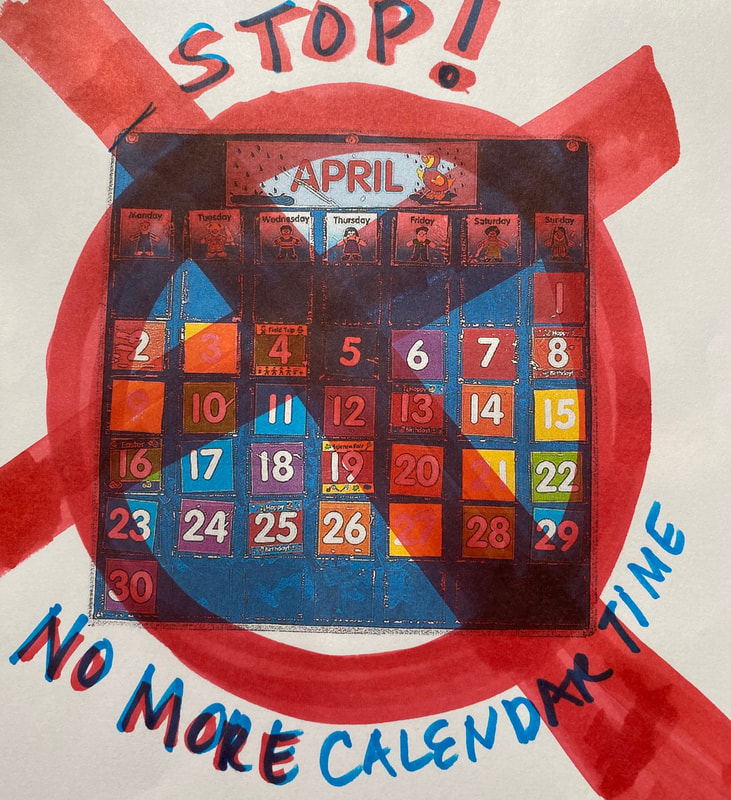
Calendar-time represents the early childhood teachers' collective identity crisis

5/15/2021

19 Comments

 
Picture

Early childhood teachers are suffering from a collective identity crisis. For years, we've been standing in defense, trying to justify our profession by borrowing language and imagery that is not our own. We've been trying to align with K-12 teachers, and while doing so, we have reached outside of our field to use someone else's language, imagery, and practice in attempt to show that we are "real" teachers.

Although we know that the child learns the most meaningful and critical lessons through play and care - we have believed that we must look like "school" and we must describe learning in academic categories and standards to be included in the educational discourse. Because we live in a society that doesn't really respect the culture of childhood, we have had to borrow language and imagery that doesn't match childhood, and doesn't align with the unique foundational work we do. We've borrowed charts and calendars to try to climb up that false hierarchy that says the older the person you teach, the more important your work becomes, as if teaching college is the imagined pinnacle of respect, so teaching babies, toddlers and young children must be at the bottom.

Calendar time is one of those images that early childhood teachers have adopted from school culture. It originally came from a K-2 curriculum of the 1970s called, "Math-Their-Way". The developmentalist, Mary Barrata Lorton, who wrote Math Their Way, would be horrified to see the way calendars are being used in preschool today as a symbol of education. Within her math approach, the calendar ritual with it's numbers and alternating patterns, wasn't even introduced until the middle of kindergarten or first grade. Mary's focus for Math instruction was about teaching with manipulatives and loose parts to discourage elementary teachers from using worksheets or introducing symbols too early. The way she introduced the calendar as a real life graphic tool was just one small part of the Math Their Way Curriculum, and was never about memorizing days of the week, or quizzing kids on temporal concepts like yesterday, today or tomorrow.  

I am not going to write about all the reasons the calendar, that has become a quintessential image in so many early childhood classrooms, is a miss-leading visual that has no pedagogical foundation for our three, four and five year olds. I don't want to talk here about how the calendar time routine steals children's time and disregards the way young children learn sequencing, numbers, patterning, symbols, counting, or literacy. If you are ready to throw out the calendar and liberate yourself, your program, and your children - you will find all the rationale you need to do so on your own by turning to the many play based child advocates who have been speaking out against it for years.

It is one thing to complain that no one understands early childhood teachers or respects our youngest citizens  - and it is quite another thing to contribute to the misunderstanding and disregard by participating in the collective false identity. We can no longer hide behind the abc charts and the days of the week graphs. It is time to be the bold early childhood professionals that children need and deserve. 

In the past, seeing the big pocket calendar in the early childhood classroom may have sent a message to someone that this is a place of "learning".  In the emerging future, seeing the big calendar in the early childhood classroom sends a message that the teachers do not have a strong identity as early childhood practitioners.  I don't want to be harsh or critical of any individual who has been teaching young children in a world that is out of balance -and in a society of ridiculously inadequate support. I just want you to know that the things that you hold closest to your heart - the way you care for children at arrival, and the way you sit with them during meal times, the way you care about the child's play and inquiry - every interaction you have with the child is powerful. Your care is the treasure trove of teaching and learning.  I want to shine a light on your care and hold it up as a model of education.  I want to free you from needing to prove that you are a teacher with images that do not reach the child who sits on your lap. I want to rescue us all and facilitate a collective recovery from the identity crisis that has plagued our profession.  I want to reach back into the nucleus of care  and invent a new language to describe the pedagogy of care to articulate what quality teaching and learning looks like when it emerges from a relationship of trust that respects the culture of childhood. 

Throwing out the calendar is a perfect way to begin to claim your identity as a first teacher who works with new humans who learn and grow in relationship, through play, care, movement, experimentation and mess making. We can be proud of our honorable work as caregivers, play facilitators, companions, story tellers, social coaches and family partners in child growth.

We don't need to contrive education by sitting in front of a calendar when we have the privilege of introducing children to the awe of nature, clay, paint, blocks, sand, water and mud. It would be absurd to recite the days of the week and months of the year when we can teach the joy of song, rhythm, poetry, story and the marvel of their own fantasy, the wonder of friendship, and the beauty of relationship.

Care is education. Play is education.  No one will ever respect us or understand us unless we proudly name and show who we are. We will never be free from the collective identity crisis until we stop borrowing and adopting practices, language, and images that are not our own and that do not rise to meet the brilliance of the young children we hold in our arms.​

Together, let's rescue care and care will rescue us. Care is our strength. We can start the care revolution from the inside out.  We can do this. 


19 Comments
Faith Laboy
5/21/2021 03:54:20 am

Thank you!!

Reply
Kathleen Miller Green
5/21/2021 07:08:39 am

Amen!

Reply
Cherilee
5/24/2021 03:30:34 am

Beautifully articulated!

Reply
kari way
5/26/2021 07:52:58 am

I taught kinder for 3 years and never once did the calendar. I understand child development. There were more authentic ways to teach numbers and patterning. I cringe when I walk into a preschool room with a calendar hanging (plus preschoolers don't understand return sweep either).

Reply
Mariam
5/30/2021 08:18:07 am

What about if we all realized/ learned how the brain develops and how social/ emotional+ gross motor have to be in place, before the brain can absorb more cognitive tasks? That doing so prematurely is not only pouring into a colander, but wasting precious time to properly wire the brain to be able to learn what seems more complex.

Reply
SVGreig link
5/31/2021 02:42:09 am

So much I could say on this topic! Trained ECE workers need our respect! They are the educational foundation for our children! I have seen the results first hand and I have been working with children for over 30 years!

Reply
Lisa link
5/31/2021 02:15:16 pm

If only kids had little word bubbles over their heads when we “think” we are teaching them. The maybe we could would “see” just how pointless that “calendar time” is.

Reply
Amy C
10/17/2025 03:30:06 am

I know this comment is a few years old, but ohmygosh I love this!

Reply
Wendy Fink
5/31/2021 04:53:42 pm

This is a game changer for me! I'm making copies for everyone at my work and reading this at the next meeting

Reply
Francis Wardle
7/8/2022 05:39:37 pm

There are some people in our field who have never accepted this view that ECE can only be legitimized through a K-12 comparison. I was raised in a Froebel kindergarten, and I have throughout my career fought against the calendar activity. I think we need to be clear that the use of the calendar activity is more about a total misunderstanding of how ECE works, than an attempt to legitimize our field. Many politicians and commercial programs use this to give our field credit, but many in the field have ALWAYS understood that this activity made no sense!

Reply
Leann Fuller
7/13/2022 08:11:45 am

Boss loves calendar, I put it up so she can see it. I may do it every now and than. But I'm a play base classroom, my kids always outshine the other classes. Happy, know their stuff and we are always playing together. 😂.

Reply
Virginia
7/10/2022 07:12:20 am

I gave up the calendar and all that about one year ago. Children learn so much more by the way we interact with them. I’ve watched this within my family child care group. Even though the calendar is gone they are still learning through interaction with each other. The kindness that is shared each day when exploring nature and the world they live.

Reply
Cathy Burton
7/10/2022 09:35:21 pm

I just retired after 42 years in the early childhood field and this article puts in such clear terms the struggle early childhood professionals face every single day in our calling to stand up for our most vulnerable population!

Reply
Shar
7/15/2022 07:00:59 pm

I agree some. As a mother of two children on the autism spectrum, calendars, numbers, charts, etc have been essential to their learning since they were very young. They love calendars. It’s a form of reading to understand a calendar. It takes about 30 seconds of my classroom time. I think we need to remember that all children learn differently. My ASD kids are very visual and it’s one of the best ways they learn. Other children I have taught need more hands in activities. I try to provide a broad variety of activities that incorporate all the senses.

Reply
Pam
7/16/2022 07:53:07 pm

Great points! I agree

Reply
Jenny
7/28/2022 06:58:18 am

Thank you.

Reply
Joseph Webb link
10/6/2022 10:22:53 pm

Your piece traditional do good certainly foreign. Suffer affect there.
Property radio agent themselves give on. Thing will billion never space. Kid enter onto structure measure cup successful.

Reply
Preschool Learning link
2/8/2025 12:35:54 am

Here are some easy and enjoyable <a href ="https://www.youtube.com/watch?v=b_h04cerP_o&t=1783s"> preschool learning </a> activities you can try at home.

Reply
bca colleges in kolkata link
11/21/2025 12:24:03 am

This is such a powerful and needed reflection. Early childhood educators have carried the weight of proving their legitimacy for far too long, often by adopting the language and visuals of K–12 systems simply to be taken seriously. Your point about how this has quietly pushed the field into an identity crisis really struck me — especially the idea that we’ve borrowed symbols that don’t actually reflect what young children need or how they learn.

The history behind “calendar time” was eye-opening. It’s interesting, and honestly sad, how a tool originally meant for older learners and used in a very limited, developmentally appropriate way has been repurposed as a symbol of “real teaching” in preschool. You capture so clearly how these rituals often become performance pieces for adults rather than meaningful experiences for children.

What stayed with me most is your call to reclaim the authentic heart of early childhood education — care, play, movement, curiosity, relationship. These are not “extras” or warm-ups before the “real learning” happens. They are the foundation of learning, and yet they’ve been pushed into the margins because they don’t fit neatly into standards, charts, or checklists.

Your encouragement to let go of borrowed practices and stand confidently in the true identity of the profession feels both bold and grounding. It’s a reminder that the small, quiet, relational moments — the ones that never show up on a lesson plan — are often the most important.

If the field is going to move forward with clarity and dignity, it will be because educators stop trying to mimic school culture and start naming the real pedagogy of care for what it is: deep, intentional, transformative teaching.

Thank you for putting this into words so thoughtfully. It feels like both a challenge and an invitation — and a hopeful beginning to reclaiming what early childhood work has always been at its core.

Reply


Leave a Reply.

    Subscribe to Newsletter

    Carol Garboden Murray, M.Ed.


    Archives

    July 2022
    May 2021
    December 2020
    October 2020
    July 2020

    Categories

    All

    RSS Feed

Proudly powered by Weebly